
Launching your MVP is the easy part. Getting real people to use it is where most founders freeze. The code is deployed, the landing page is live, and suddenly the product is out in the world — but nobody is showing up. This is the stage where founders who validated well still stall out, because building and distributing are genuinely different skills. The good news is that your first 100 users do not come from scale tactics. They come from focused, manual, slightly uncomfortable outreach that does not require a marketing budget or a growth team. If you have not yet launched and are still figuring out whether to build, start with how to validate a startup idea before building an MVP.
1.
2.
3.
4.
5.
6.
7.
8.
9.
10.
Why the First 100 Users Matter More Than the Next 10,000
It is tempting to dismiss the first 100 users as a small, noisy sample. They are not. This group gives you three things no paid campaign can buy later.
First, feedback velocity. With 100 engaged users, you can personally email every one of them, jump on a 15-minute call with a quarter of them, and watch how the rest behave in your product analytics. That kind of signal is gone by the time you reach 1,000 users — the volume drowns out the individual voices.
Second, word-of-mouth seeding. Early users who genuinely love the product become your first organic growth channel. A Reddit comment, a Slack community mention, or a LinkedIn post from a real customer outperforms any ad you could run, because it comes with built-in trust.
Third, activation data. The metrics that matter in the first 90 days after launch are behavioral — activation rate, time-to-first-value, retention at day 7 and day 30. You cannot measure those with zero users. Your first 100 are the dataset that tells you whether the product actually works, not just whether the idea sounded good on a landing page.
Skipping this stage or trying to shortcut it with paid ads is the most common mistake founders make post-launch. The math rarely works on cold paid acquisition until your funnel is already tuned, and tuning a funnel requires the very users you are trying to skip past.
Start With Warm Channels Before Cold Ones
Your first users should come from people who already know you or know of you. Not because cold channels are bad, but because warm channels are faster, cheaper, and produce better feedback.
Make a list of every person who fits your target customer in some way. Former coworkers, classmates, LinkedIn connections, friends of friends, people who replied to your validation interviews, anyone who joined a waitlist or commented on a build-in-public post. Do not batch-email them. Send individual messages that reference something specific — a conversation you had, a problem they mentioned, a role they currently have. The conversion rate on 50 personal messages will beat a 5,000-person newsletter blast almost every time.
If you ran a landing page test during validation, your email list is already a warm channel. Those people signed up for a reason. Write to them the day you launch. Explain what changed, what you are opening up, and what you want from them — usually a 10-minute trial and a one-sentence reply afterwards. If you skipped the landing page step, it is not too late to build one, and it pays dividends long after launch. See how to build an MVP landing page that validates your idea.
Expect a conversion rate from warm outreach in the 15 to 30 percent range if your message is specific and your product actually solves the problem they care about. If you are below 5 percent, the problem is not the channel — it is either the message or the product fit.
Go Where Your Users Already Gather
Once warm channels are exhausted, find the places your target customer already spends time online. The word "already" is doing a lot of work in that sentence. You are not trying to build a new community. You are showing up in one that already exists.
Reddit works for consumer products and developer tools. Find the 3 to 5 subreddits where your customer hangs out, read them for two weeks without posting, learn the norms, then participate authentically. Most subreddits forbid direct self-promotion, but almost all of them allow you to answer questions, share what you learned, or mention your product when it is genuinely relevant. The founders who do well on Reddit treat it as a conversation, not a billboard.
Slack and Discord communities are strong for B2B and niche audiences. Indie Hackers, MegaMaker, specific industry Slacks — join, be useful for a month before you mention what you are building, and when you do, mention it in context. A single helpful comment thread can drive more signups than a week of cold outreach.
LinkedIn is underrated for B2B if you post consistently about the problem you solve, not the product you sell. Three posts a week about the problem space, one every two weeks about the product, is a healthy ratio. Reply to comments. DM people who engage. Most of your first B2B users will come from conversations that started in a LinkedIn comment section.
Niche forums, Facebook groups, and industry-specific communities are often the highest-conversion channels because they are smaller and more focused. If your product serves dentists, wedding photographers, or aquarium hobbyists, those communities absolutely exist and they are where your first 20 power users will likely come from.
The universal rule for community-based acquisition: give three times more than you take. Answer questions, share resources, help people without an agenda. The credit compounds, and when you eventually mention your product, nobody minds.
Want more to read?
How to Collect Feedback That Shapes Your MVP Into a Real Product
Early users are the best source of product direction you will ever have. Learn how to collect, filter, and act on feedback that turns a working MVP into a product people love.
 Read More
Launch on Aggregator Platforms Strategically
Aggregator platforms can get you to 100 users in a weekend if they go well, and they are worth the effort even if the results are modest. Each has its own rhythm.
Product Hunt is still the most well-known launch platform. A good launch can drive 500 to 2,000 visitors and 50 to 300 signups in a single day. Preparation matters more than the product itself. Line up hunters, draft your taglines in advance, have a demo video ready, schedule the launch for early Tuesday morning Pacific time, and mobilize your warm network to engage in the first two hours. A cold Product Hunt launch rarely performs well.
Hacker News Show HN is unpredictable but powerful. A post that resonates can bring 10,000 visitors and hundreds of signups. A post that does not simply disappears, which is fine. The rules are strict — no marketing language, a simple and specific title, a short comment from the founder in the thread explaining what you built and why. HN audiences reward honesty and punish hype.
BetaList, Indie Hackers, Launching Next, and similar directories are lower-volume but consistent. They are worth submitting to as a batch in the week after your main launch. None will 10x your traffic, but collectively they can add a steady trickle of relevant signups.
Do not launch on every platform simultaneously. Stagger them across 4 to 6 weeks so each gets its own attention window and so you can apply lessons from one launch to the next.
Use Content as a Compounding Channel
Paid channels turn off the moment you stop paying. Content keeps working. The catch is that content takes time, and "time" is the one resource most early founders underestimate. Start anyway, because a single blog post that ranks for a specific long-tail query can drive users for years.
Write about the problem you solve, not the product you built. If your product helps freelance designers track project hours, write about why designers struggle to estimate project timelines, not about your time-tracking features. Search traffic comes from people with problems, not people looking for products.
One problem per post, one clear answer, specific numbers where possible. Target long-tail keywords that a real customer would type — "how to X when Y," "best way to Z for W." Those queries are easier to rank for than head terms and they convert better because the search intent is sharper.
Founder-story content — lessons learned, public launches, failures and iterations — builds an audience that follows you as a person. Newsletter subscribers from that audience often become your most engaged users, because they already trust your judgment.
If content marketing feels overwhelming at this stage, the basics are enough: publish one useful post every two weeks, link internally between posts, and keep showing up for six months before you evaluate whether it is working.
When (and How) to Run a Small Paid Test
Paid ads are not off-limits at this stage — they are just a bad first move. Once you have 25 to 50 organic users and you can see what converts, a small paid test can accelerate the next 50. Not before.
Cap the budget at $200 to $500. Run on a single channel — Meta, Google, Reddit, or LinkedIn depending on where your audience lives. One creative, one landing page, one audience. If the cost per signup comes in under what a customer is worth to you, double the budget and keep going. If it comes in way over, stop and go back to organic.
The point of a small paid test is to learn whether paid works at all for your category, not to scale. Treat the $500 as tuition. Write down what you learned regardless of outcome. Most early founders burn through paid budgets not because the ads were bad, but because they scaled before they learned.
For the broader economics of getting an MVP in front of customers efficiently, see why founders who invest in an MVP early save time and money later.
Turn Early Users Into Advocates
Every one of your first 100 users is a potential distribution channel. Most founders do not ask, and so most users do not share. The fix is simple: ask, and make it easy.
Referral loops do not need to be sophisticated. A single email at the right moment — typically when a user has just experienced a clear win in the product — asking them to share with one person, with a one-click prefilled message, outperforms most built-in referral systems at this scale.
Testimonials are distribution you can reuse forever. After a user tells you the product is working, ask if you can quote them on your site and LinkedIn. Most will say yes. A homepage with five specific, named testimonials converts noticeably better than one with none.
Build-in-public updates turn your existing users into an audience. A weekly or biweekly update — what you shipped, what broke, what you learned — gives early users a reason to stay engaged and gives prospective users a reason to trust you. Post the updates publicly, not just to customers, so the audience compounds.
The goal is to make every happy user slightly more visible than they would be by default. You are not asking them to be a marketing team. You are just reducing the friction of the one share they might already be willing to make.
The Activation Metrics That Prove the Funnel Is Working
Getting 100 signups is not the same as getting 100 users. The difference is activation — whether those signups actually experienced the core value of the product.
Three numbers are worth tracking from day one:
Activation rate — the percentage of signups who complete the core action in their first session. For a task manager, that might be creating and completing a task. For an analytics tool, connecting a data source and viewing a dashboard. Below 40 percent activation usually means the onboarding is broken, not the product.
Day 7 retention — of the people who activated, how many came back a week later. This is the earliest retention signal that actually predicts long-term stickiness. A healthy Day 7 for most SaaS products is 30 to 50 percent of activated users.
Time to first value — how long between signup and the user's first meaningful outcome. Shorter is always better. If this is measured in days, you have an onboarding problem. If it is measured in minutes, you have a chance.
Tracking these before you scale acquisition is what separates founders who build sustainably from founders who pour budget into a leaky funnel. For the full framework, read how to measure MVP success — metrics and KPIs every founder should track.
Want more to read?
How to Measure MVP Success — Metrics and KPIs Every Founder Should Track
The metrics that actually predict whether an MVP is working — and how to set them up without a data team. Activation, retention, and the founder-level KPIs that matter in the first 90 days.

Common Traps on the Road to 100 Users
A few patterns reliably stall founders at this stage. Watching for them saves weeks.
Chasing vanity signups. 500 signups from a viral tweet who never come back are worth less than 50 signups from a niche forum who use the product weekly. Judge the channel by activation, not by signup volume.
Over-relying on one channel. If 80 percent of your users come from a single subreddit, one moderator decision can wipe out your growth overnight. As soon as one channel works, start testing the next.
Launching everywhere at once. Stacking Product Hunt, Show HN, BetaList, a newsletter send, and a LinkedIn post all in the same day is tempting because it feels efficient. In practice it fragments your attention and means none of the channels gets the follow-through it needs.
Building new features instead of distributing. The urge to add a feature is often a way to avoid the harder work of outreach. Unless the lack of a specific feature is the reason users are bouncing, resist it. Your first 100 users came for the core value, not for more surface area.
Ignoring the feedback. The reason you went through the effort to get 100 real users is the feedback they generate. Founders who do not read support emails, do not talk to users on calls, and do not revisit their analytics weekly waste the only advantage this stage provides. For common patterns to watch for, see seven signs your MVP development project is going off track.
Final Thoughts
Your first 100 users are not a growth number. They are a learning dataset and a distribution seed. Warm outreach gets you the first 20. Community participation gets you to 50. One aggregator launch pushes you past 75. Content and referrals carry you across 100. Paid ads might accelerate a late stretch if the funnel is tuned. None of this requires a marketing team or a budget — it requires consistent, focused, slightly uncomfortable work for roughly 60 to 90 days after launch.
The founders who cross this threshold get two rewards. They have a real product used by real customers, which turns every future conversation — with investors, hires, partners — into an easier one. And they have the feedback signal they need to make the product actually good, not just functional. Both of those compound.
At PremierMVP, we help founders move from a validated idea to a production-ready MVP in 14 to 20 days. A full MVP starts at $1,999 and a landing page starts at $799. You own 100% of the code. No equity, no hidden fees.
Have a business idea you want to bring to life? Book a call today with PremierMVP.
Want more to read?
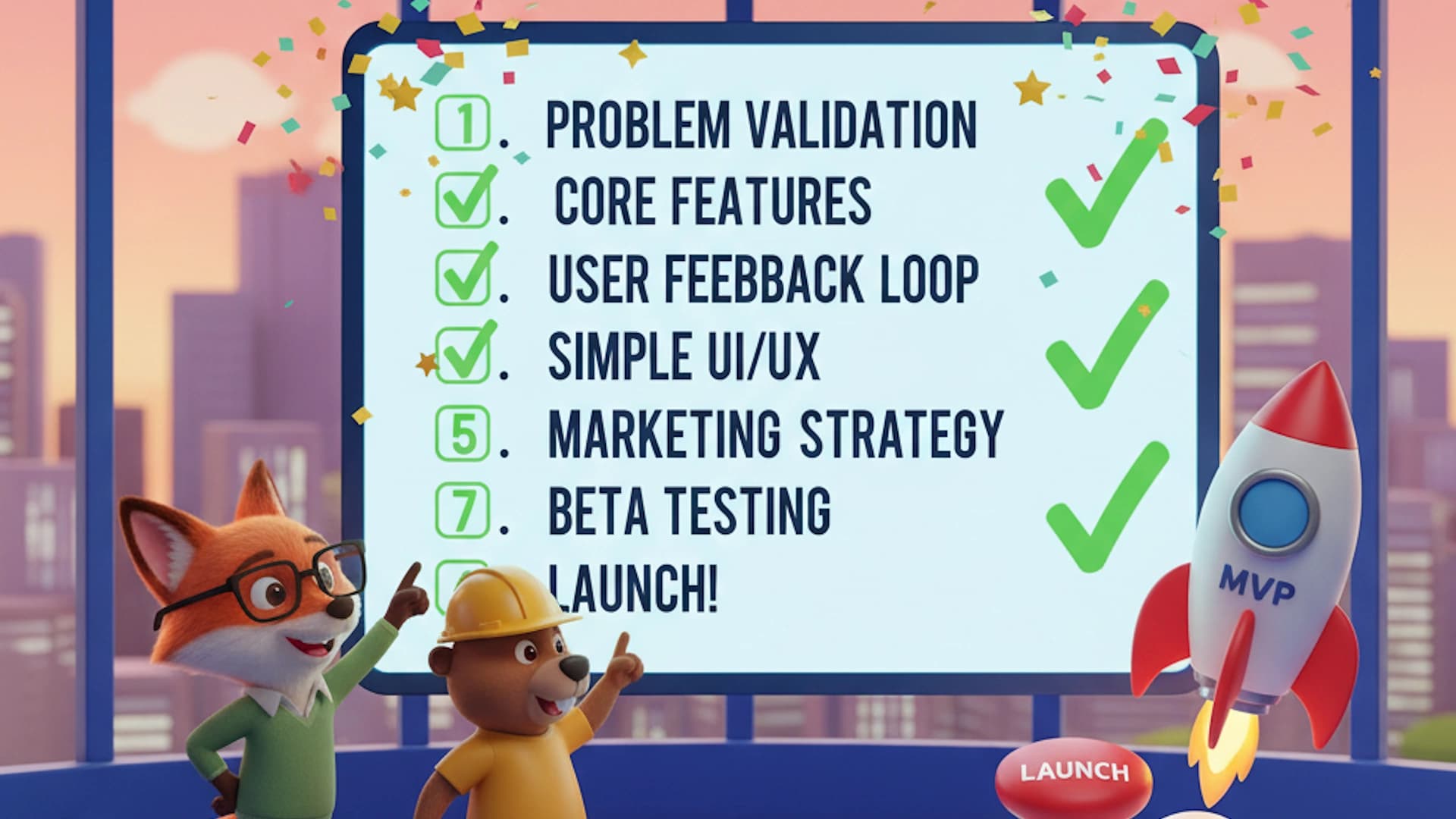
The Essential Checklist for Your First Startup MVP Launch
Launch your first MVP with confidence using this checklist that covers problem focus, feedback, metrics, and strategy to help you save time and learn faster.