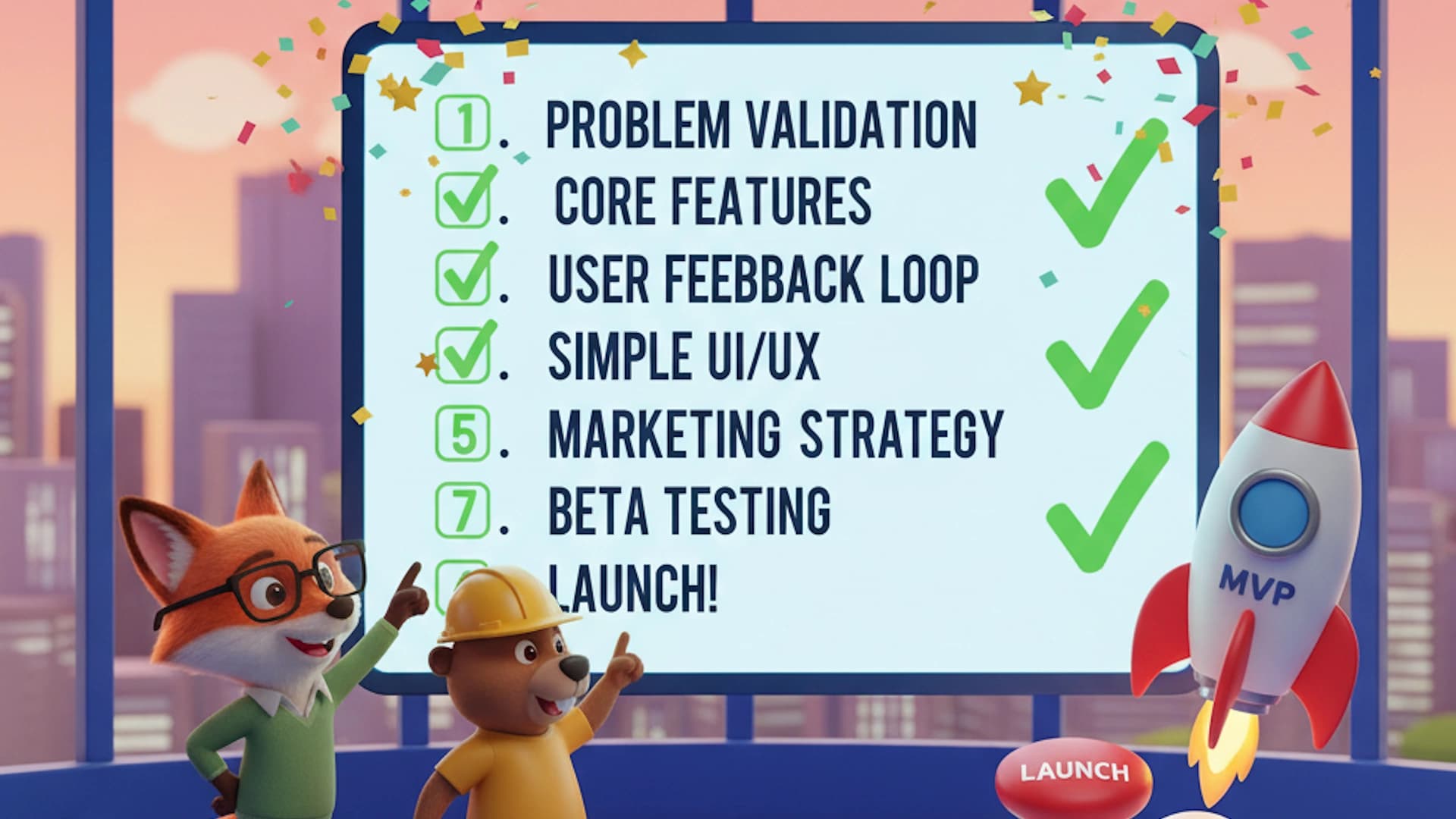

Most startups do not fail because the code was bad or the design was ugly. They fail because nobody wanted what they built. CB Insights has analyzed hundreds of startup post-mortems, and the number one reason startups go under is building a product with no market need. Not running out of money. Not getting outcompeted. Building something nobody asked for. Validation is how you avoid becoming that statistic. It is the work you do before you spend a dollar on development to make sure the idea is worth building at all. If you are still getting oriented on what an MVP actually is, start with what every founder should know about building an MVP.
1.
2.
3.
4.
5.
6.
7.
8.
9.
Why Validation Comes Before Building
Building an MVP costs real money. Even a lean, focused MVP typically runs $15,000 to $50,000 and takes four to twelve weeks. A landing page alone costs time and attention to build well. Spending that money on an idea you have not validated is a gamble, and it is one that most founders lose.
Validation is not market research. Market research tells you the industry is growing and the total addressable market is large. Validation tells you whether specific people will take specific actions — sign up, pay, share, switch from their current solution. Those are very different things. A billion-dollar market does not help you if nobody in that market wants your particular product.
There is also a difference between validation and a proof of concept. A proof of concept answers a technical question: can we build this? Validation answers a business question: should we build this? You need both, but validation comes first. There is no point proving you can build something if nobody wants it.
The good news is that validation is cheap. Most of the methods in this guide cost nothing but your time. A few require a small ad budget. None require writing code. And the clarity you get from validation is worth more than any feature you could build, because it tells you whether the features matter at all.
Step 1 — Define the Problem You Are Solving
Before you talk to anyone, get clear on the problem. Not your solution. Not your product idea. The problem. Write it down in one sentence from the customer's perspective: "I struggle with X because Y, and existing solutions fail because Z."
Here is what a good problem statement looks like: "I struggle to find reliable contractors for home renovations because most platforms show me hundreds of options with no way to verify quality, and existing solutions fail because reviews are easily faked and there is no accountability after the job is done."
Here is what a weak one looks like: "People need a better way to find contractors." That is too vague to validate. You cannot test whether people agree with a statement that broad because everyone will nod and say sure. The specific version gives you something to probe. You can ask homeowners whether they have actually experienced this. You can ask whether fake reviews have burned them. You can ask what they currently do instead.
If you cannot fill in each part of that sentence with specifics, you do not know the problem well enough yet. That is not a failure. It just means you need more conversations before you start building anything.
One useful filter: distinguish between nice-to-have problems and hair-on-fire problems. A nice-to-have problem is something people acknowledge but do not actively try to solve. A hair-on-fire problem is something people are already spending time, money, or energy working around. Startups win on hair-on-fire problems. If the people you talk to are not already doing something about the problem — even something clunky and manual — the problem may not be painful enough to support a product.
Step 2 — Talk to Real People
Surveys are tempting because they scale. You can send a Google Form to a hundred people and get data back in a day. But at this stage, surveys are the wrong tool. They give you what people say they would do, not what they actually do. And people are terrible at predicting their own behavior.
Interviews are better. Not because they are more rigorous in a statistical sense, but because they let you follow up. When someone says "yeah, that is annoying," you can ask "tell me about the last time it happened." When someone describes a workaround, you can ask "how much time does that take you every week?" You cannot do that with a checkbox.
You need fifteen to twenty conversations before patterns start to emerge. That sounds like a lot, but each one only takes twenty to thirty minutes. You are not building a statistically significant dataset. You are looking for repeated themes — the same frustrations, the same workarounds, the same language showing up across multiple conversations.
Where to find people
Go where your target customers already spend time. LinkedIn is effective for B2B — search for people with the right job title and send a short, honest message explaining that you are researching a problem and would appreciate fifteen minutes of their time. Reddit communities are useful for consumer products. Local meetups and industry events work for niche markets. If you have friends or former colleagues in the target market, start there.
What to ask
The best interview questions focus on past behavior, not hypothetical willingness.
Good questions:
- "Tell me about the last time you dealt with [problem]."
- "What do you currently do to solve this?"
- "How much time or money do you spend on this per month?"
- "What is the most frustrating part of your current approach?"
Bad questions:
- "Would you use an app that does X?"
- "How much would you pay for this?"
- "Do you think this is a good idea?"
The bad questions are bad because they invite people to be polite. Nobody wants to tell an enthusiastic founder that their idea is not good. So they say "yeah, I would probably use that" and then never think about it again. Past behavior does not lie. If someone tells you they spent three hours last week manually doing the thing your product automates, that is a real signal. If they say "sure, that sounds useful" but cannot describe a single time they experienced the problem, that is a warning.
After you have done your interviews, the skills you developed will transfer directly into the feedback loops you will need once you have a product. For more on that stage, read about how to collect feedback that shapes your MVP into a real product.
Step 3 — Research the Competitive Landscape
Some founders worry when they discover competitors. They should not. Competition means a market exists. It means people are already spending money to solve the problem you identified. The absence of competition is far more concerning — it often means there is no market, not that you found a hidden opportunity.
What you want to understand is the shape of the competition. Map three categories:
Direct competitors solve the same problem with a similar approach. If you are building a project management tool for freelancers, other freelancer project management tools are direct competitors.
Indirect competitors solve the same problem with a different approach. For the same example, a spreadsheet template or a virtual assistant service might be an indirect competitor. They address the same pain but in a completely different way.
DIY workarounds are the duct-tape solutions people cobble together themselves. These are often the most revealing because they show you exactly what people care about enough to spend effort on, and exactly where those solutions fall short.
For each competitor, note three things: what they do well, where they fall short, and what their customers complain about. App store reviews, G2 reviews, Reddit threads, and Twitter complaints are goldmines for this. Pay special attention to negative reviews that describe the same frustration repeatedly. That pattern is your opening.
The goal is not to build a product that does everything your competitors do but better. The goal is to find a gap — a specific customer segment, use case, or experience that existing solutions handle poorly — and own it. That gap is what makes your MVP worth building.
Want more to read?
How to Build an MVP as a Non-Technical Founder
A practical guide for non-technical founders on how to plan, build, and launch your first product — without writing code yourself.
 Read More
Step 4 — Test Demand Before You Build
Talking to people and researching competitors gives you qualitative confidence. Testing demand gives you quantitative proof. This is where you move from "I think people want this" to "I can show that people want this."
There are three practical ways to test demand without building a product.
Landing page test
Put up a simple page that describes your product as if it already exists. Include a clear value proposition, a brief explanation of how it works, and a call to action — either a waitlist signup, an email capture, or a "notify me when this launches" button. Then drive traffic to it with a small ad budget, typically $200 to $500 on Google or Meta ads targeting your ideal customer.
What you are measuring is the conversion rate. If five to ten percent of visitors sign up, that is a strong signal. If less than two percent sign up, either the positioning is wrong or the problem is not painful enough. For the full playbook on this approach, read about how to use landing pages to validate startup ideas before you build and how to build an MVP landing page that validates your idea.
Pre-sell or crowdfund
The strongest form of validation is someone paying you money before the product exists. If you can get ten people to put down a deposit, pre-order, or back a crowdfunding campaign, you have evidence that is almost impossible to argue with. This works especially well for B2B products, where you can approach potential customers with a pitch deck and ask for a letter of intent or an early-access payment.
Pre-selling is uncomfortable because it requires asking for money when you have nothing to deliver yet. But that discomfort is the point. If people will not pay when the only thing they are buying is the promise of a solution, the problem is probably not painful enough to support a business.
Concierge or manual delivery
Instead of building software, deliver the value manually to a handful of customers. If your product idea is an AI tool that generates weekly marketing reports, create those reports by hand for five clients. If your idea is a marketplace that connects dog owners with vetted sitters, match them yourself through text messages.
This approach validates two things at once: whether people want the outcome and whether your specific approach to delivering it works. You will learn more from manually serving five customers than from months of product planning. And if you cannot deliver the value manually, that is worth knowing before you try to automate it.
Step 5 — Validate the Business Model, Not Just the Idea
An idea can be validated while the business model is broken. People might genuinely want what you are building, but if it costs you $200 to acquire each customer and they only pay $50 per year, the math does not work. Validating the business model means testing whether the economics make sense, not just whether the product is desirable.
Three questions matter at this stage:
Will people pay, and how much? Your interviews and pre-sell experiments should give you directional data. If people consistently say they would pay $20 per month but balk at $50, that tells you something important about your revenue ceiling.
How will you acquire customers? Even rough estimates matter. If your plan is paid ads, what does a click cost in your category? If your plan is content marketing, how long will it take to build organic traffic? If your plan is partnerships, have you talked to a single potential partner?
Do the unit economics work? A simple exercise: estimate your customer acquisition cost, multiply it by the number of customers you would need to cover your costs, and compare that to a realistic revenue per customer number. If the gap is enormous, the business model needs work even if the idea is solid.
Founders who validate the business model early avoid the trap of building a product people love but cannot sustain. For more on the economics of early-stage investment, read about why founders who invest in an MVP early save time and money later.
Red Flags That Your Idea Needs More Work
Not every idea passes validation, and that is the point. Here are the warning signs that should make you pause before investing in a build:
Nobody can articulate the problem without prompting. If you have to explain the problem before people agree it exists, the pain is not sharp enough. Real problems do not need an explanation. People recognize them instantly.
People say "that sounds cool" but will not commit. Enthusiasm without action is meaningless. If interviewees love the concept but will not sign up for a waitlist, put down a deposit, or even give you their email address, their interest is superficial.
The competitive landscape is crowded and you have no clear differentiator. Competition is fine. Competition where every player is well-funded, well-established, and doing a decent job is a different story. If you cannot point to a specific gap you are filling, you are entering a fight you are unlikely to win.
You cannot describe your target customer in specific terms. "Small business owners" is not a target customer. "Solo accountants with fewer than fifty clients who currently track expenses in spreadsheets" is a target customer. If you cannot get that specific, you have not done enough research.
Everyone suggests a different use case. When every person you talk to sees your idea as solving a different problem, the idea is too vague to build around. A product that tries to be everything to everyone ends up being nothing to anyone.
These warning signs do not necessarily mean the idea is dead. They mean it needs more work — more conversations, a sharper focus, or a different angle. Catching these signals now is dramatically cheaper than catching them after a build. For similar warning signs that show up during development, read about seven signs your MVP development project is going off track.
Want more to read?
MVP Pitfalls: Common Mistakes Founders Make and How to Avoid Them
Avoid the most common MVP mistakes that cost founders time and money. Learn what traps to watch for and how to sidestep them before they derail your launch.
Green Lights — When You Know It Is Time to Build
Validation is not meant to last forever. At some point, the signals are clear enough to move forward. Here is what those signals look like:
Multiple people describe the same problem unprompted. When five or ten interviewees independently bring up the same frustration using similar language, you have found a real pain point. This is the strongest qualitative signal you can get.
People take action, not just express interest. Waitlist signups, deposits, pre-orders, letters of intent — any commitment that costs the person something (even just their email address and attention) is worth more than a hundred polite nods.
You can clearly describe who the customer is and why existing solutions fail them. If you can say "my customer is X, they currently deal with this problem by doing Y, and that fails because Z" with confidence and specificity, you have done the work.
Your rough business model makes economic sense. You do not need a perfect financial model. You need a believable story about how the revenue per customer exceeds the cost to acquire and serve them. If the math works even on the back of a napkin, that is enough to move forward.
You feel the pull to build, not the push. The best time to start building is when the evidence is pulling you forward — when you are excited because the data supports the idea, not when you are pushing through doubt because you want to believe it works.
When you see these signals, the next step is scoping what to build. Start with how to go from concept to launch in weeks for the full process, and use a framework for prioritizing which features to include so you build only what matters for the first version.
Final Thoughts
Validation is not a delay. It is the fastest path to a product people actually want. The founders who skip it often spend months building in the dark, only to discover that the market has already spoken — just not to them. The founders who validate first build with conviction and waste nothing.
The five steps are straightforward. Define the problem in specific terms. Talk to fifteen or twenty real people and listen for patterns. Research the competitive landscape to find your opening. Test demand with a landing page, pre-sales, or manual delivery. And validate that the business model works, not just the idea.
None of this requires code. None of it requires a large budget. All of it requires honesty — the willingness to hear that your idea needs work and the discipline to act on what you learn. That honesty is what separates founders who build products people want from founders who build products nobody asked for.
At PremierMVP, we help founders move from a validated idea to a production-ready MVP in 14 to 20 days. A full MVP starts at $1,999 and a landing page starts at $799. You own 100% of the code. No equity, no hidden fees.
Have a business idea you want to bring to life? Book a call today with PremierMVP.
Want more to read?
The Essential Checklist for Your First Startup MVP Launch
Launch your first MVP with confidence using this checklist that covers problem focus, feedback, metrics, and strategy to help you save time and learn faster.