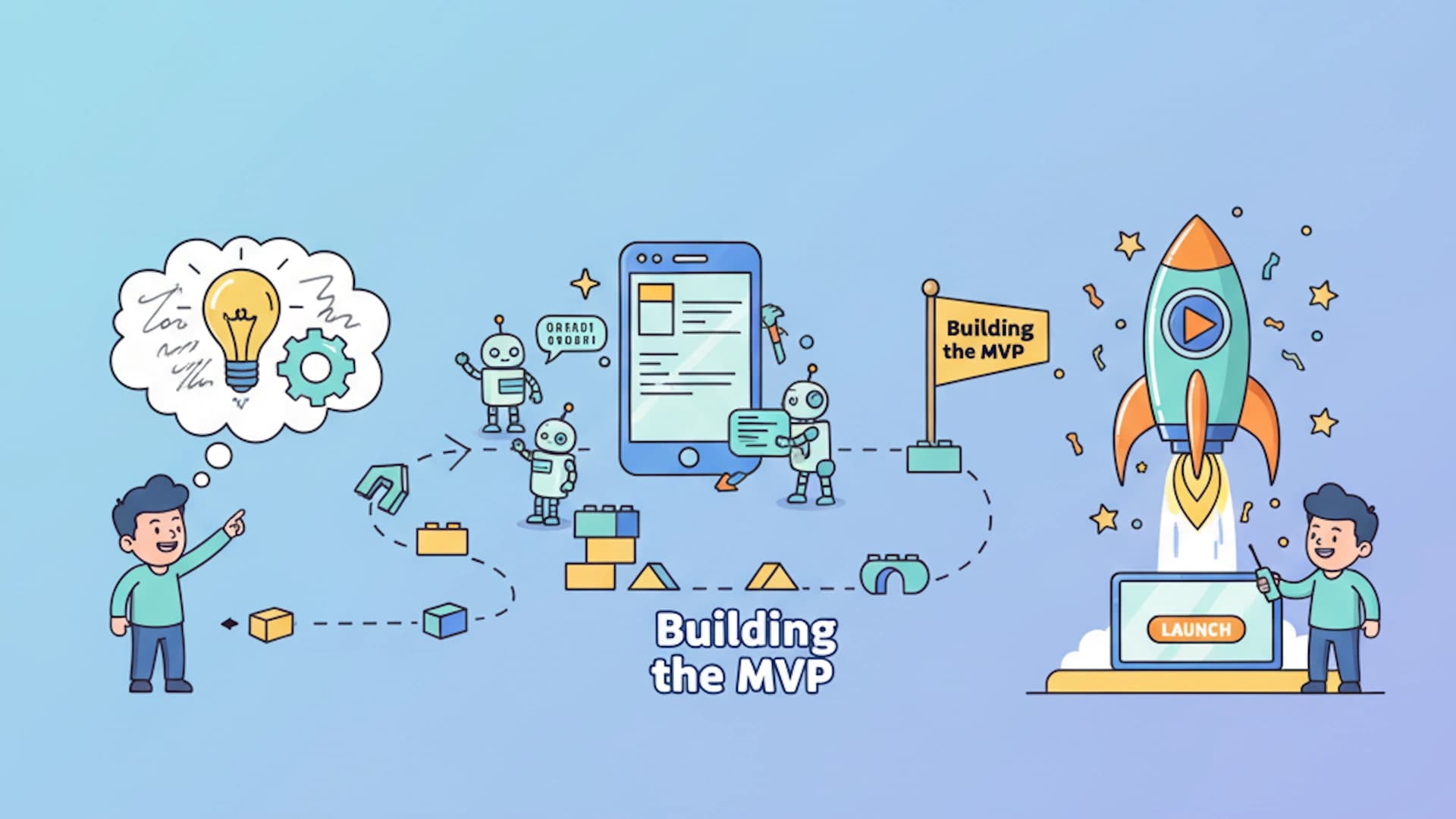
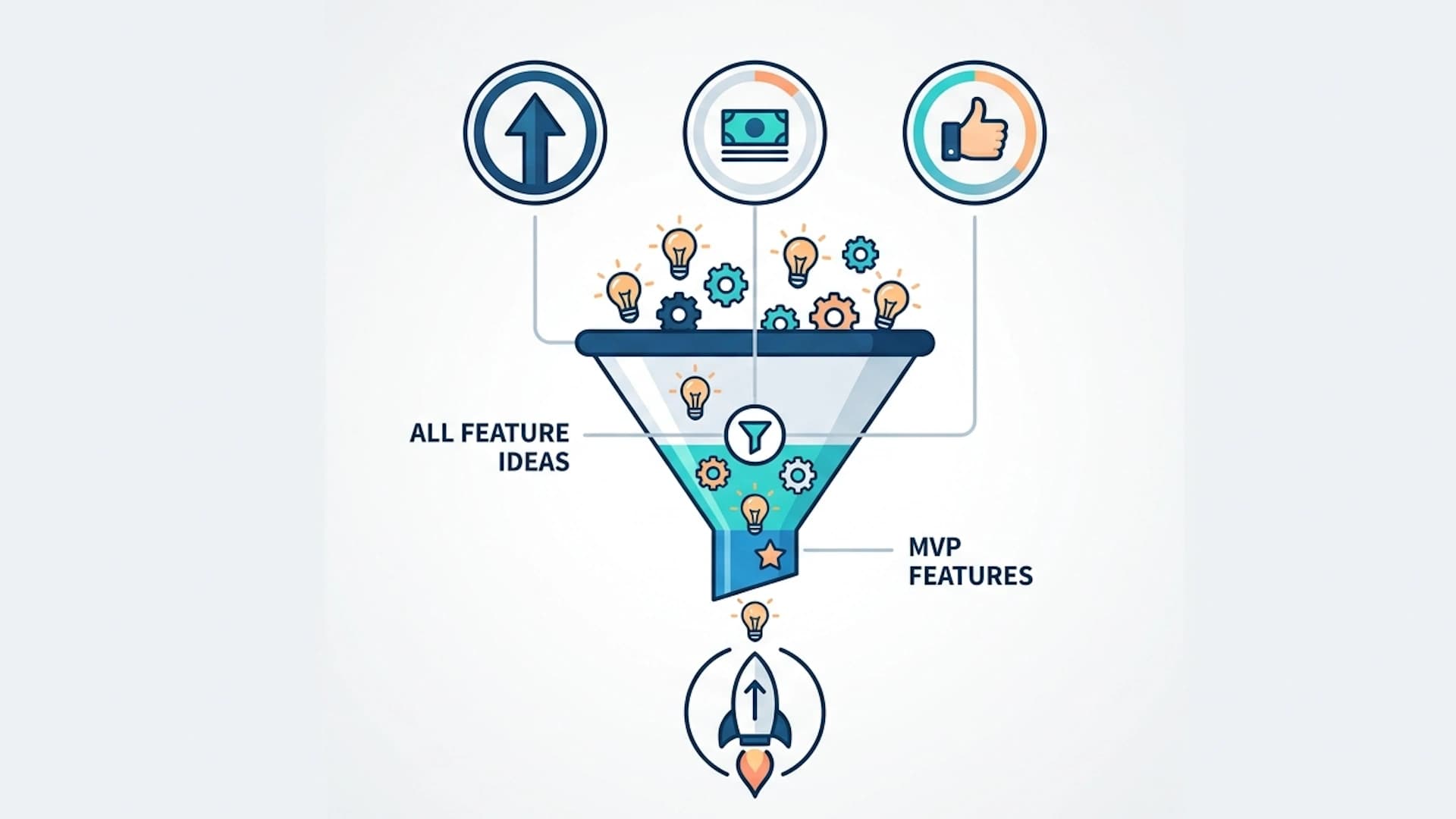
Every founder starts with the same problem. The feature list keeps growing. What began as one clean idea on a napkin turns into a thirty-item spreadsheet by the end of week two. Every feature feels essential. Every cut feels risky. And the longer the list gets, the further away launch day drifts. Here is the truth experienced builders learn the hard way: the founders who ship are not the ones with the best feature lists. They are the ones who get ruthless about what to leave out. If you are still working out the basics, start with what every founder should know about building an MVP.
1.
2.
3.
4.
5.
6.
7.
8.
9.
Why Most MVPs Fail at the Whiteboard
Most MVPs do not fail because the code was bad or the market was wrong. They fail because the scope was too big from the start. A founder writes down twenty features, a developer estimates each one, the timeline doubles, the budget triples, and three months later there is still nothing live. By the time the product ships, the team is exhausted, the runway is gone, and nobody has tested any of it on a real user.
Scope creep is not a discipline problem. It is a prioritization problem. When every feature feels equally important, the only way forward is to build them all. The fix is not more willpower. The fix is a framework that forces you to compare features against each other and make explicit trade-offs. Without that framework, the loudest opinion in the room wins, and the loudest opinion is usually the founder who is excited about a feature they thought of last night. For a fuller list of early-stage traps to avoid, read about the most common MVP pitfalls founders make and how to avoid them.
Start With the Core User Journey
Before you reach for any prioritization framework, do this exercise. Write down the single workflow that delivers the value your product promises. Not the homepage, not the settings page, not the password reset flow. The actual sequence of steps a user takes to get the thing they came for.
For a project management tool, the core journey might be: sign up, create a project, add a task, mark it done. For a marketplace, it might be: browse listings, message a seller, complete a purchase. For an AI tool, it might be: paste input, get output, save the result. That is it. Five or six steps at most. Everything that touches that journey is a candidate for the MVP. Everything that does not touch it is a candidate for the cut list.
This sounds obvious until you actually try it. You will find that most of the features on your spreadsheet are not on the critical path. They are conveniences, nice-to-haves, or things you imagined a future user might want. None of them are required for someone to experience the core value of your product. Cut them, and your scope will collapse to roughly a third of where it started. That is not a failure. That is the entire point of an MVP.
The MoSCoW Method (And When to Use It)
Once you have a rough list of features that touch the core journey, you need a way to sort them. The MoSCoW method is the simplest framework that actually works. It splits every feature into one of four buckets: Must-have, Should-have, Could-have, and Won't-have.
Must-have features are the ones without which the product does not function. If you remove them, the core user journey breaks. For a marketplace, payment processing is a must-have. So is a way to list a product and a way to message a seller. These are non-negotiable.
Should-have features are important but not critical for the first version. They make the product better, but the product still works without them. For the same marketplace, search filters might be a should-have. Users can scroll the full list for the first hundred listings, and you can build filters in the second release once you know which filters people actually want.
Could-have features are improvements that would be nice to have if there is extra time. Profile customization, dark mode, advanced notifications. None of these change whether the product works. They get cut from the MVP and revisited only after launch.
Won't-have features are explicitly off the table for this version. Writing them down is just as important as cutting them silently, because it stops the conversation from coming back week after week. When someone asks why you are not building integrations with Slack, you can point to the list and move on.
The reason MoSCoW works is that it forces a conversation. You cannot have ten must-haves. The whole point is that the must-haves are the smallest possible set. If your must-have list has more than five or six items, you have not been honest yet. Go through them again and downgrade the ones that survive without breaking the core journey.
The RICE Framework for Tougher Calls
MoSCoW is great for the obvious decisions, but it falls apart when you have two features that both feel like must-haves and you can only build one. That is where RICE comes in. RICE stands for Reach, Impact, Confidence, and Effort. You score each feature on the first three, divide by effort, and the higher number wins.
Reach is how many users the feature will affect in a given period. A feature that touches every signup is higher reach than one that only affects the small percentage of users who reach a specific edge case.
Impact is how much the feature improves the experience for those users. Something that fundamentally enables a workflow scores higher than something that makes an existing workflow slightly more pleasant.
Confidence is how sure you are that your reach and impact estimates are right. A feature based on direct user interviews scores high. A feature based on a hunch scores low. This is the dial that keeps founders honest about how speculative their assumptions are.
Effort is how much engineering time the feature will take. This is the denominator, so cheap features that solve real problems for many users always rise to the top of the list.
You do not need precise numbers. Even rough scores on a one-to-five scale will quickly show you which features are obviously worth building and which are not. The framework matters less than the discipline of comparing features side by side instead of evaluating each one in isolation. In isolation, every feature looks worth building. Side by side, the trade-offs become obvious.
Want more to read?
How to Use AI to Build Your Startup MVP
A practical guide to using AI coding tools like Cursor, Lovable, and Claude Code to build your startup MVP faster — what works, what doesn't, and when you still need human developers.
 Read More
The "One-Sentence Pitch" Filter
Here is a filter you can apply in about thirty seconds, and it cuts more features than any framework. Write the one-sentence pitch for your product. Something like: "A tool that lets freelancers send invoices and get paid in under a minute." Now look at every feature on your list and ask whether it is required for that sentence to be true.
Recurring billing? Not required. Time tracking? Not required. Expense reports? Not required. Multi-currency? Not required. Send an invoice and get paid in under a minute. That is the entire promise. Anything that does not directly support that promise is a feature for version two, three, or never.
This filter works because it ties every prioritization decision back to the value you are actually delivering. Founders drift away from the pitch because they want the product to feel "complete." But complete is the enemy of shipped. The pitch is what you sell. The MVP is the smallest thing that proves the pitch is real. Anything more is decoration.
What to Cut First (Even Though It Hurts)
Once you start applying these filters, certain categories of features will keep showing up on the cut list. Cutting them is painful because they feel like the markers of a "real" product. They are not. They are the markers of a product built by someone who is afraid to launch. If you are noticing your project drifting, read about seven signs your MVP development project is going off track.
Settings and preferences pages. If a user can complete the core journey with the defaults, they do not need to change them yet. Every settings toggle is engineering time you could spend on the actual product.
Admin dashboards. You are the admin. You can use the database directly for the first hundred users. Build the admin tools when you actually need them.
Edge cases. What happens if a user enters a negative number? What if they try to upload a thirty-gigabyte file? Most edge cases will never happen with your first hundred users. Handle the happy path well and leave the edge cases for version two.
Third-party integrations. Slack, Zapier, Salesforce, Google Calendar. Each integration is a week of work and a permanent maintenance burden. Build them when a paying customer asks, not before.
Social features. Comments, sharing, follow buttons, activity feeds. Unless social is the core of your product, these are bolted on. Cut them.
Email digests and notifications. A daily summary email is a feature that takes a week to build and that most users will turn off immediately. Send transactional emails only.
Each of these cuts will feel risky. Each of them will save you weeks. Founders who launch are the ones who make these cuts and trust that the second release can fix anything that turns out to be a real problem.
How Prioritization Affects Cost and Timeline
Prioritization is not just about what gets built. It is the single biggest lever you have on cost and timeline. Every feature you cut saves engineering hours, design hours, QA time, and post-launch maintenance. A focused MVP with five features costs a fraction of an unfocused MVP with twenty, and it ships in weeks instead of months. For a full breakdown of the numbers, read about how much it costs to build an MVP.
The compounding effect is even bigger than the line-item savings. Fewer features mean fewer bugs, simpler architecture, faster iteration, and easier user testing. A small product can pivot in a week. A bloated product cannot pivot at all because every change ripples through twenty interconnected features. Founders who cut hard get to market faster, learn faster, and iterate faster, which is the entire point of building an MVP in the first place. For more on realistic timelines, see how long it takes to build an MVP.
Want more to read?
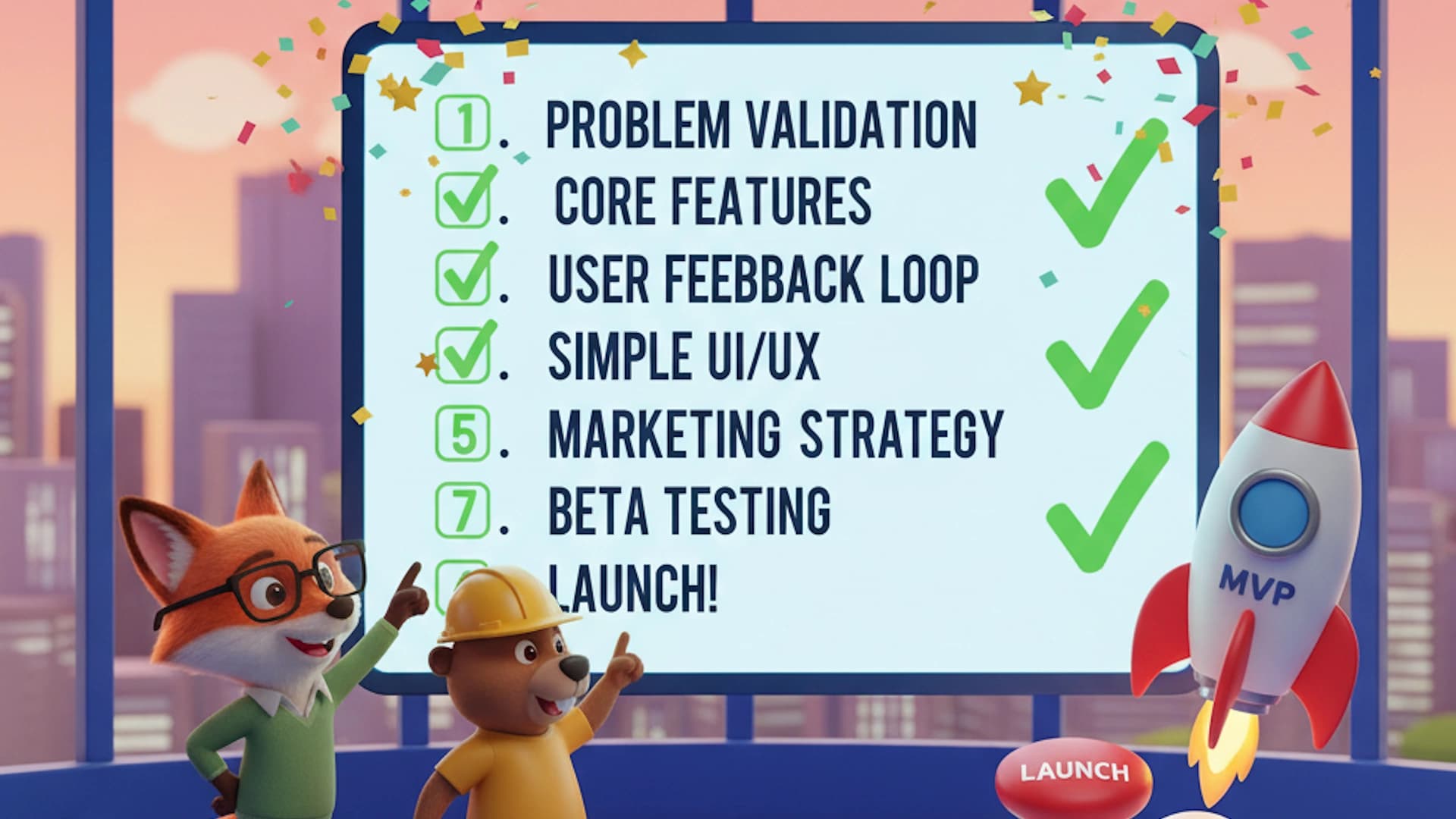
Essential Checklist for Your MVP Launch
Launch your first MVP with confidence using this checklist that covers problem focus, feedback, metrics, and strategy to help you save time and learn faster.
Common Prioritization Mistakes Founders Make
Even with a framework, founders make the same mistakes when they sit down to prioritize. Knowing the patterns helps you catch them before they cost you a month of build time.
Building for investors instead of users. Founders sometimes prioritize features that will make a pitch deck look impressive rather than features that will make a real user successful. Investors are not your user. The user is the only person who matters at the MVP stage. Build for them.
Copying competitors feature for feature. It is tempting to look at an established competitor and assume you need everything they have. You do not. Their product evolved over years in response to real customer feedback. Yours has not earned that complexity yet. Copying their full surface area is the fastest way to ship a worse version of an existing product.
The "we'll need it eventually" trap. Every cut feature will provoke this objection. Yes, you will probably need it eventually. But eventually is not now. Building something now because you might need it in six months is exactly the kind of work an MVP is designed to avoid. Build it when "eventually" arrives, not before.
Letting developers scope the product. Developers are great at building. They are not always great at deciding what to build. When you ask a developer what features should be in the MVP, they will often answer with what is technically interesting or what would create a clean architecture. That is not the same as what your users need. Founders own the prioritization decision. Developers execute it.
Confusing feedback with feature requests. Early users will ask for things. Most of those requests are not new features, they are signals that something in the existing experience is unclear or broken. Treat feature requests as data, not as a to-do list. For more on how to interpret what users are actually telling you, read about how to collect feedback that shapes your MVP into a real product.
Final Thoughts
The hardest part of building an MVP is not writing the code. It is deciding what not to write. Every framework in this guide — MoSCoW, RICE, the core user journey, the one-sentence pitch — exists for the same reason: to give you permission to cut. The founders who launch and learn are the ones who treat their feature list as a problem to be reduced, not a wish list to be completed. Build the smallest thing that proves your idea. Ship it. Let real users tell you what to build next. That is how every successful product started, and it is how yours will too.
At PremierMVP, we help founders make these prioritization calls every day, then build the resulting MVP using battle-tested technology chosen for speed and reliability. A full MVP starts at $1,999 and ships in 14 to 20 days. A landing page starts at $799 and ships in 7 to 12 days. You own 100% of the code. No equity, no hidden fees, no scope creep that pushes your launch by months. Just a focused, production-ready product built around the features that actually matter.
Have a business idea you want to bring to life? Book a call today with PremierMVP.
Want more to read?
From Idea to MVP: Launch in Weeks
Learn how to turn your startup idea into a working MVP in weeks by validating your concept, building fast, and launching with confidence to real users.